Interpol Red Notice Removal
Specialist lawyers for Red Notice removal through the CCF. We prepare legal submissions, challenge politically motivated notices, and restore your freedom of movement.
📋 On This Page
An Interpol Red Notice can effectively end your freedom of movement. It signals to border authorities in 196 countries that you are sought for arrest and surrender. Even without a formal extradition treaty, many states act on Red Notices — and the consequences of arrest far from home, in an unfamiliar legal system, can be severe. Red Notice removal through the Commission for the Control of Interpol’s Files (CCF) is the established legal route to reclaiming your freedom.
An Interpol Red Notice is removed through a formal challenge to the Commission for the Control of Interpol’s Files (CCF) — Interpol’s independent supervisory body — which can order the notice deleted when it breaches Interpol’s own rules.
- The CCF reviews the notice against Interpol’s Constitution (Article 3), its Rules on the Processing of Data (RPD) and data-protection principles — success on any one ground is enough.
- It is not a criminal trial: a Red Notice can be deleted even where the underlying allegations are well-founded, if it was issued in breach of the rules.
- The main grounds are political motivation (Article 3), human-rights risk, failure of the seriousness threshold, and procedural or data-quality defects.
- A well-documented evidence pack is the single biggest factor in the outcome.
- A challenge can run in writing from Cyprus and in parallel with a pending criminal case; interim suspension can be requested at the outset.
- The process typically takes 12–24 months, and a deleted notice cannot be reinstated without a fresh submission that faces added scrutiny.
Understanding the CCF Review Process
The Commission for the Control of Interpol’s Files (CCF) reviews Red Notice challenges against three primary sets of criteria: (1) Interpol’s constitutional rules — primarily Article 3 (prohibition on political, military, religious, or racial activities); (2) Interpol’s Rules on the Processing of Data (RPD) — the detailed procedural and data quality requirements for notice issuance; and (3) general data protection principles applicable to personal data processed by an international organisation. A Red Notice challenge can succeed on any one of these grounds independently — an application does not need to establish all three simultaneously.
The CCF review is not a criminal trial — it does not determine guilt or innocence of the underlying offence. It determines only whether Interpol’s processing of data about the individual complies with Interpol’s own rules. This distinction is important: even in cases where the underlying criminal allegations are well-founded, the Red Notice can be challenged and deleted if it was issued in violation of Article 3 (political motivation), if it concerns conduct that does not meet Interpol’s threshold requirements, or if it contains data that does not meet Interpol’s quality standards.
Grounds on Which a Red Notice Can Be Deleted
| Ground | Basis in Interpol’s rules | When it applies |
|---|---|---|
| Political motivation | Constitution Article 3 | The notice serves political, military, religious or racial aims — e.g. it targets an opponent, dissident or journalist. |
| Human-rights risk | Interpol rules + ECHR standards | Enforcement would expose the person to persecution, torture, inhuman treatment or a flagrantly unfair trial. |
| Seriousness threshold / dual criminality | Rules on the Processing of Data (RPD) | The conduct falls below Interpol’s threshold or relates to a civil or commercial dispute. |
| Procedural or data-quality defect | RPD data-quality rules | Incomplete documentation, no valid national arrest warrant, or the NCB issued the notice without proper authority. |
The Red Notice Removal Process — Step by Step
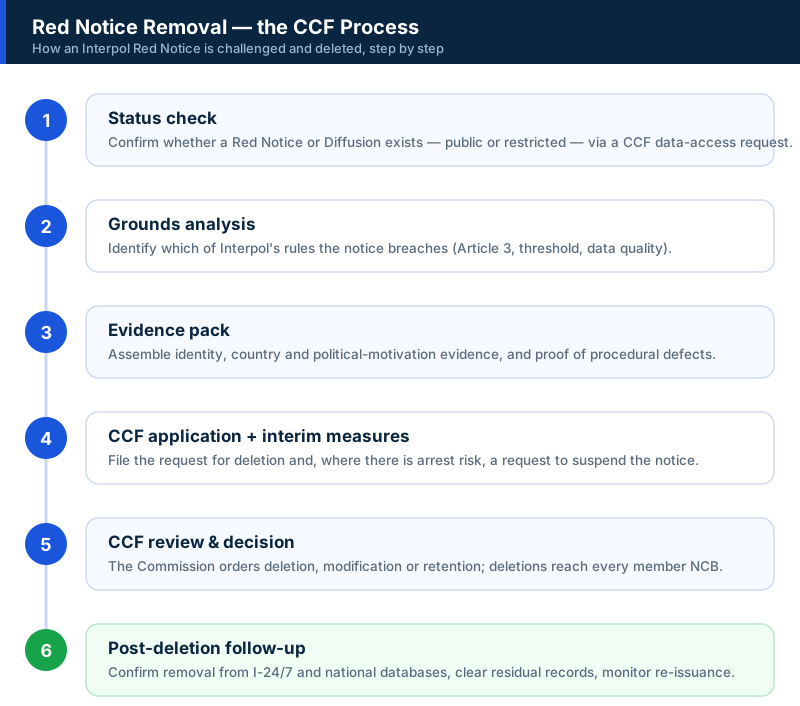
- Status check. Confirm whether a Red Notice or Diffusion exists — public or restricted — through a CCF data-access request.
- Grounds analysis. Identify which of Interpol’s rules the notice breaches and map the strongest grounds of challenge.
- Evidence pack. Assemble identity, country and political-motivation evidence, any refugee or asylum determination, and proof of procedural defects.
- CCF application with interim measures. File the request for deletion and, where there is a real risk of arrest, a simultaneous request to suspend the notice pending review.
- CCF review and decision. The Commission examines the file and orders deletion, modification or retention; deletions are communicated to every member NCB.
- Post-deletion follow-up. Confirm removal from Interpol’s I-24/7 network and national databases, clear any residual records, and monitor for re-issuance.
Building the Evidence Base for Red Notice Removal
The quality of the evidence submitted to the CCF directly determines the likelihood of success. The most effective CCF applications are built on a comprehensive, well-organised evidence pack that addresses each ground of challenge with specific documentation. Key evidentiary categories include:
- Identity and personal background: Full personal documentation establishing the applicant’s identity, nationality, residence history, professional background, and family circumstances.
- Nature of the allegations: Analysis of the specific charges in the notice, the legal basis for the charges in the requesting state’s law, and the factual background of the alleged offence.
- Political motivation evidence: Where the Article 3 ground is raised — country expert reports, ECHR judgments, human rights organisation reports, evidence of the applicant’s political or public role, and evidence of similar notices being issued against other opponents of the same government.
- Refugee or asylum status: Any formal determination by UNHCR or a state authority of refugee or subsidiary protection status is directly relevant and should be included.
- Procedural defects in the notice: Evidence that the notice does not comply with Interpol’s formal requirements — for example, the charges do not constitute extraditable offences, the documentation is incomplete, or the requesting NCB issued the notice without proper authority.
How Long Red Notice Removal Takes
| Stage | Typical timeframe |
|---|---|
| CCF data-access enquiry (confirm a notice exists) | 3–6 months |
| Request for interim measures (suspension) in urgent cases | often within 3–6 months |
| Full CCF challenge through to a deletion decision | 12–24 months |
| Parallel national-court protection in Cyprus | can be faster and runs alongside |
After Red Notice Removal — What Comes Next
Successful Red Notice removal clears the primary threat, but the legal work does not end there. Following a CCF deletion decision, several follow-up steps are important: confirming that the notice has been removed from Interpol’s I-24/7 system and national databases; assessing whether a Diffusion exists separately from the notice and whether it also needs to be challenged; addressing any residual effects on national police databases, visa records, and financial screening databases; and monitoring for any attempt by the issuing country to re-issue the notice or to issue a new notice on different grounds. We provide ongoing legal support following a successful Red Notice removal to ensure that the full practical benefits of the deletion are realised. For further reading, see our guide on all Interpol legal services.
Frequently Asked Questions
A CCF decision deleting a Red Notice is a formal determination that the notice violated Interpol’s rules. Interpol communicates the deletion to all member NCBs. The issuing country’s NCB is notified that the notice has been deleted. The deleted notice cannot be reinstated without a new submission by the issuing NCB — and any new submission would be reviewed by Interpol’s General Secretariat with knowledge of the previous CCF deletion. While re-submission is theoretically possible, the existence of a prior CCF deletion on the same facts creates a significant additional obstacle for the issuing country.
Yes, in limited circumstances. Interpol’s General Secretariat reviews all notices and can delete or modify them independently if it identifies a violation of Interpol’s rules during its own review process. However, this self-correction mechanism is not reliable for the subject of the notice — it depends on Interpol’s own review process identifying the problem without an application. A formal CCF application is the authoritative route to Red Notice removal and the only mechanism that provides a formal, reviewable decision with clear legal effects.
The CCF has jurisdiction over both public and restricted Red Notices. A restricted notice is not publicly visible but is accessible to law enforcement agencies in member countries. The CCF challenge process is identical for both public and restricted notices — the application is submitted to the CCF in the same way, and the CCF reviews both categories under the same rules. If you know or suspect that a restricted notice exists, we can begin the CCF process to confirm its existence and challenge it.
Yes. The CCF reviews the notice on Interpol’s own rules — it does not defer to the outcome of criminal proceedings in the requesting state. A pending criminal case in the requesting state does not prevent a CCF challenge. In fact, a CCF challenge filed while criminal proceedings are pending in the requesting state can create a parallel legal front that puts pressure on the requesting state’s narrative and may influence the outcome of those proceedings.
Red Notice removal removes the specific alert in Interpol’s system, which eliminates the risk of Interpol-facilitated provisional arrest. However, extradition from Cyprus does not depend exclusively on an Interpol notice — a formal extradition request through treaty channels can be made separately, without any Interpol notice. Red Notice removal is therefore one component of a comprehensive anti-extradition strategy, not a complete solution on its own. We advise on the full scope of legal protection required in each specific case.